
Diaphragm Switch
Manufactured by BinMaster & Distributed by Wm. Neundorfer & Co.
The simple, low-cost, proven point level switch for high-, low-, and plugged-chute detection in bins, silos, and chutes—free-flowing dry bulk solids.
BinMaster’s authorized Diaphragm Switch distributor for the Great Lakes region —
65 years specifying the right model, diaphragm material, and mount for your material, environment, and mounting location.
Get an application-specific recommendation
Tell us about your vessel. Wm. Neundorfer & Co. will spec the right diaphragm switch—model, diaphragm material, and mount—for your material, environment, and process.
or call (440) 350-7460
Trusted across the Great Lakes region since 1959
Local Inventory
stocked in Painesville, OH
65 Years of
Bulk Material Handling Expertise
Serving the Great Lakes Region
OH, PA, WV, NY
Key Specs
Technology
Diaphragm Switch
Electromechanical micro-switch
Installation
Internal and External
Varies based on specific model
Diaphragm Material
3 Materials
3 options to meet the needs of your application.
Why the diaphragm switch is the most economical point-level alarm in Great Lakes grain, feed, cement, and bulk facilities
The lowest-cost reliable level alarm you can install
A diaphragm switch has nothing to calibrate and no signal to aim. Material presses a flexible diaphragm against a sensitive micro-switch, and the switch trips. Wire it to a light, horn, alarm, motor starter, or BinMaster point-level alarm panel — it’s the simplest, lowest-cost way to put a dependable high- or low-level alert on a bin.
Almost nothing protrudes into the vessel (External Install)
There’s no paddle to turn and no probe to insert — just a sealed diaphragm at the bin wall or roof and a micro-switch behind it. No rotating parts, no shaft to bend, and nothing in the flow path to wear or snag. The molded-nylon or die-cast aluminum housing shrugs off dust, moisture, and vibration.
One product family, ordinary location to explosion-proof
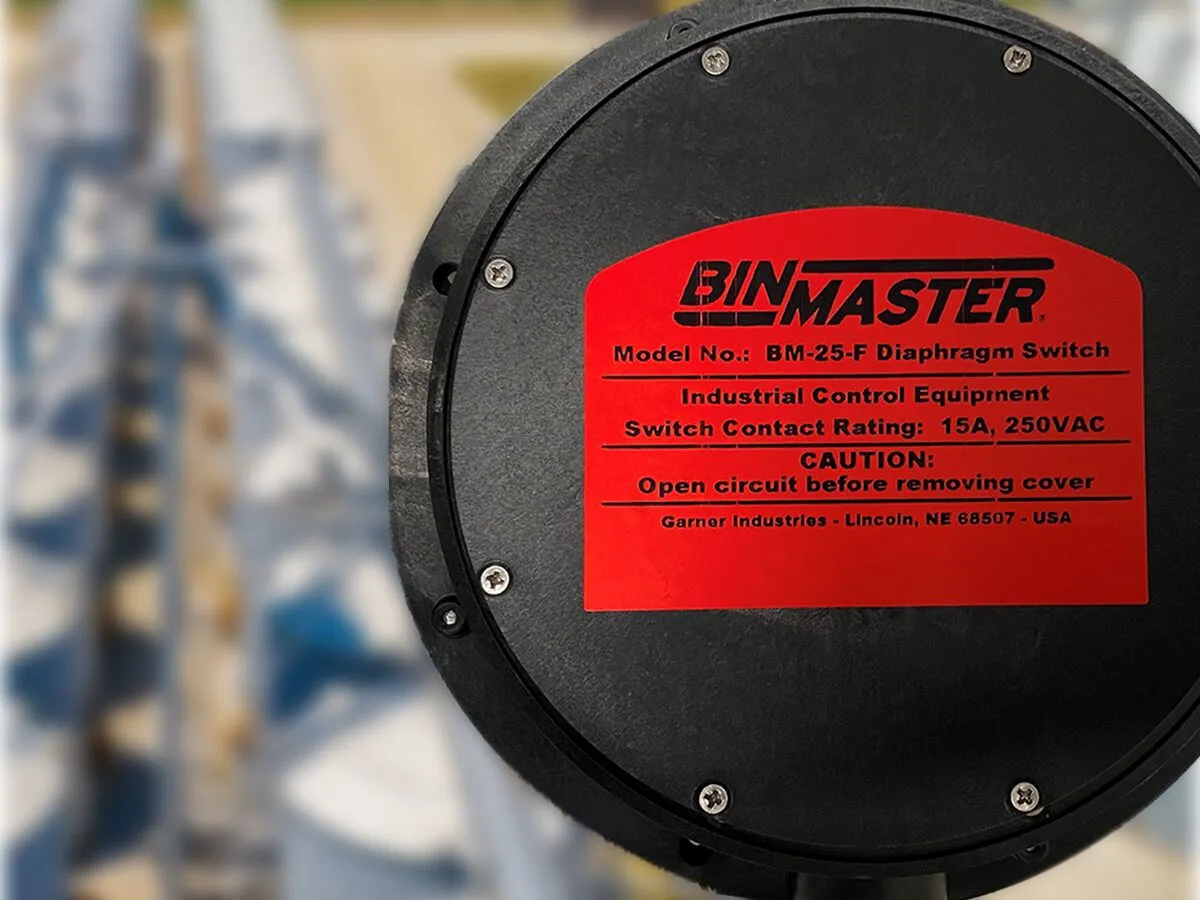
The BM-25 covers economical alerts in ordinary (non-hazardous) locations; the BM-45 adds a die-cast aluminum housing with more mounting and voltage options; and the BM-65 carries UL Class II, Groups E, F & G approvals for combustible-dust environments. Match the diaphragm — neoprene, neoprene with nylon mesh, or silicone — to the material’s density and temperature.
Catches plugged chutes before they make a mess
Heavy-spring plugged-chute models (BM-65-FHPC and BM-65-RHPC) alert when a chute or conveyor backs up with material, so you stop the line before the spill, not after — with explosion-proof certification for dusty transfer points.

Models
Three families built on the same proven pressure-switch principle. They differ in housing, the density and temperature range they cover, and whether the location is hazardous.
| Model | Highlight | Applications |
|---|---|---|
| BM-25 | Economical molded-nylon housing with a silicone diaphragm. Internal or external mount. Ordinary (non-hazardous) locations. | Budget high/low alerts on grain, feed, seed, and fertilizer bins |
| BM-45 | Die-cast aluminum housing, neoprene or silicone diaphragm, multiple mounting and voltage options. Non-hazardous. | Heavier-duty service and a wider density and temperature range than the BM-25 |
| BM-65 | Explosion-proof, UL Class II, Groups E, F & G. Die-cast aluminum, full diaphragm choice, internal or external mount. | Combustible-dust and classified areas — grain dust, coal, flour, sugar, plastic powders |
| BM-65-FHPC | External mount heavy spring and rugged diaphragm material to detect material buildup in transfer chutes. When material blocks the chute, the diaphragm activates an alarm connected to a horn, siren, light, or control panel. | Alerting on clogged chutes and conveyors before a spill |
| BM-65-RHPC | Internal mount heavy spring and rugged diaphragm material to detect material buildup in transfer chutes. When material blocks the chute, the diaphragm activates an alarm connected to a horn, siren, light, or control panel. | Alerting on clogged chutes and conveyors before a spill |
Configure your diaphragm switch to your application
Diaphragm switches are used across a wide range of materials, vessels, and mounting locations. To keep detection reliable wherever it’s deployed, the diaphragm material and the mounting style are matched to your material’s density, temperature, and the location’s hazard classification. Not sure which configuration fits? Tell us about your application, and we'll spec the right configuration for you.

Industries where the diaphragm switch is the low-cost point-level standard
Serving industrial facilities across Ohio, Pennsylvania, West Virginia, and Western New York since 1959. Find your application below — or tell us about your vessel and we'll spec the right model.
Grain and Feed
Corn, soybean meal, wheat, barley, milo, DDGs, and ground feed in elevators, feed mills, and ethanol plants. The economical high/low alert on storage and surge bins.
Common fit:
BM-25 or BM-45 + silicone or neoprene diaphragm
Cement and Aggregate
Cement, fly ash, lime, and aggregate in batch plants and storage silos. Silicone handles hot fly ash; combustible cement dust calls for the explosion-proof BM-65.
Common fit:
BM-65-RHT (hot ash, hazloc) or BM-45-FHT
Plastics and Resins
Virgin and regrind resin pellets, masterbatch, and ground polymer in day tanks, hoppers, and railcar silos. Plastic powders in classified areas use the BM-65.
Common fit:
BM-25 or BM-45; BM-65 where dust is classified
Power Generation
Coal, fly ash, limestone for FGD, and bottom ash. Combustible coal and ash dust call for the explosion-proof BM-65; silicone handles hot ash.
Common fit:
BM-65-RHT or BM-65-FH + silicone diaphragm
Mining and Minerals
Aggregate, salt, lime, fertilizer, frac sand, potash, bentonite, and alumina. Dense, abrasive solids use the nylon-mesh diaphragm for higher bulk density.
Common fit:
BM-45-RH or BM-65-RH (up to 90 lb/ft³)
Bioenergy and Wood
Wood pellets, chips, bark, and sawdust at pellet plants and biomass-fueled facilities. Combustible wood dust in classified areas uses the BM-65.
Common fit:
BM-25 / BM-45 for pellets; BM-65 in dust-classified areas
Food
Rice, oats, sugar beets, flour, and sugar in dry storage. Combustible flour and sugar dust call for the explosion-proof BM-65; silicone suits warmer product.
Common fit:
BM-45 or BM-65 + silicone diaphragm

