
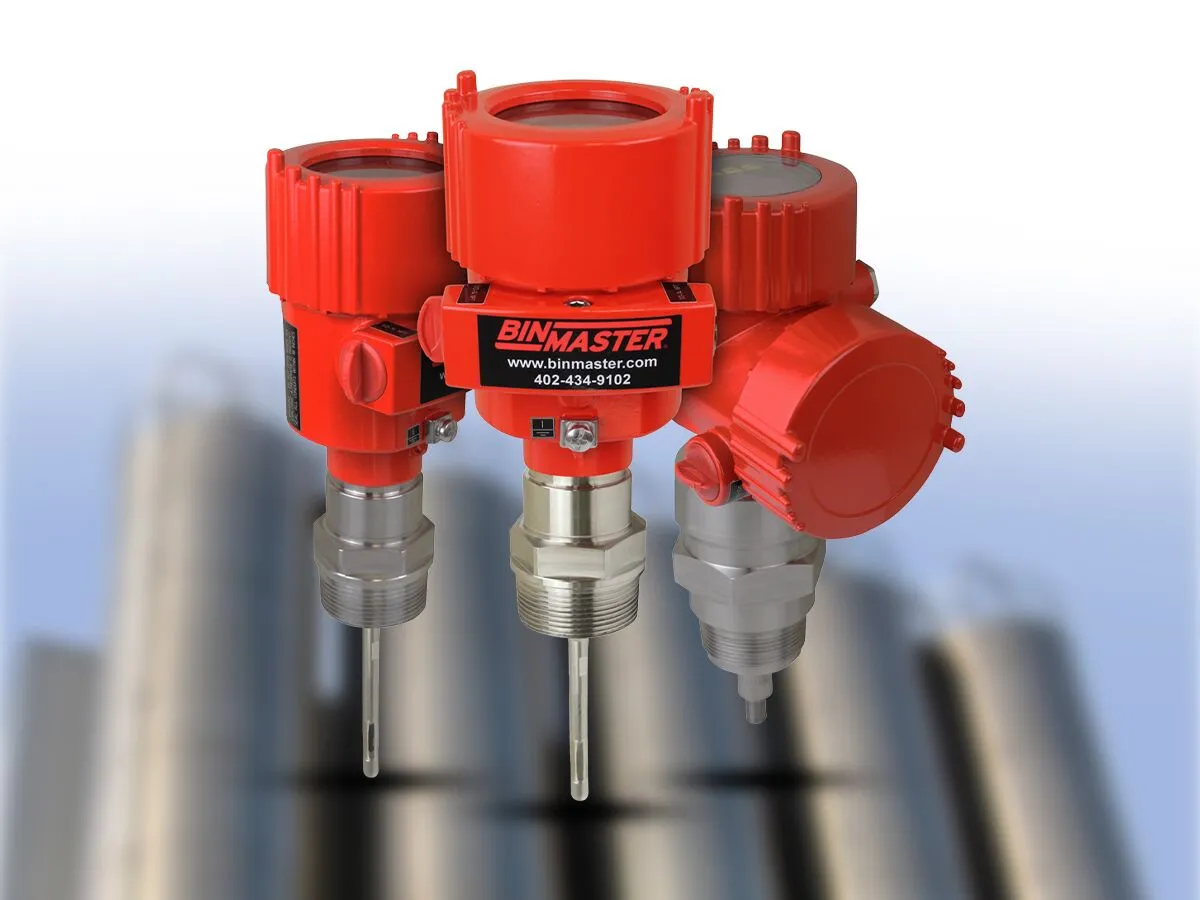
Guided Wave Radar
Manufactured by BinMaster & Distributed by Wm. Neundorfer & Co.
Inventory level measurement for low-dielectric, dusty, and narrow vessels—bulk solids and liquids.
BinMaster’s authorized Rotary Point Level Indicator distributor for the Great Lakes region —
65 years specifying the right guided wave radar for your application.
Get an application-specific recommendation
Tell us about your vessel. Wm. Neundorfer & Co. will spec the right guided wave radar—probe, mounting, and output—for your material, environment, and process.
or call (440) 350-7460
Trusted across the Great Lakes region since 1959
Local Inventory
stocked in Painesville, OH
65 Years of
Bulk Material Handling Expertise
Serving the Great Lakes Region
OH, PA, WV, NY
Key Specs
Technology
TDR
Time domain reflectometry
Measuring Range
Up to 100ft
Varies based on specific model
Accuracy
±0.08in (2mm)
Both GWR Models
Why guided wave radar is the right call when non-contact radar struggles
Reads low-dielectric materials other sensors miss
The guided signal travels along the cable or rod instead of through open space, so it measures reliably in materials with a dielectric constant as low as 1.3 — dry plastic powders, fine grains, and light bulk solids that weak-reflecting non-contact radar can lose.
The signal ignores dust, vapor, condensation, and noise
Because the pulse is guided down the probe, it shrugs off the conditions that fool open-air sensors — heavy dust during fill, steam and condensation, and the noise of material moving in and out of the vessel.
Fits narrow, chambered, and corrugated vessels
A rod or cable drops straight down where a radar beam would have nowhere clean to aim. That makes Guided Wave Radar a strong fit for narrow silos, bypass tubes and standpipes, and corrugated or chambered vessels.
One technology for solids, liquids, and liquid interfaces
The GWR-2000 handles powders and bulk solids; the GWR-3000 handles liquids and reports the oil/water interface in separators and tank farms. Both push data straight to a PLC, BinCloud, or Binventory.

Models
Two guided wave radar models, organized by application
Two BinMaster GWR models on the same TDR platform: the GWR-2000 for bulk solids and the GWR-3000 for liquids and interface measurement. Send us the application and we’ll spec it for you.
| Model | Highlight | Best at |
|---|---|---|
| GWR-2000 | Bulk-solids model. Continuous TDR level measurement in vessels up to 100 feet tall with accuracy of ± 0.08 inches (2mm) | Powders, granules, pellets, and other bulk solids in challenging conditions like high dust, air movement, or excessive noise |
| GWR-3000 | Liquid level model. Measure levels at distances up to 75ft with an accuracy of ± 0.08 inches (2mm) | Liquid storage tanks or standpipes often installed for tank metering at tank farms. It measures separation layers for interface measurement in tanks, bypass tubes, or standpipes. |
Configure your guided wave radar to your application
Every Guided Wave Radar is built to order. Probe style and length, mounting, and output are configured to your vessel, material, and control system. Not sure which configuration fits? Tell us about your application, and we'll spec the right mount for you.

Industries where the rotary is the point-level standard
Serving industrial facilities across Ohio, Pennsylvania, West Virginia, and Western New York since 1959. Find your application below — or tell us about your vessel and we'll spec the right model.
Grain and Feed
Corn, soybean meal, DDGs, and ground feed in elevators, feed mills, and ethanol plants. Guided wave radar holds accuracy on low-dielectric grain and in narrow silos where a radar beam has little to reflect off.
Common fit:
GWR-2000 + flexible cable for tall silos; 4–20 mA or Modbus RTU to the mill office
Plastics and Resins
Virgin and regrind resin pellets, masterbatch, and ground polymer in day tanks and rail-car silos. Dry, low-dielectric plastics are exactly where the guided signal pays off.
Common fit:
GWR-2000 + rod or cable; ResinView in BinCloud
Cement and Aggregate
Cement, fly ash, lime, and aggregate in batch plants and storage silos. The guided pulse cuts through heavy fill dust that challenges open-air sensors.
Common fit:
GWR-2000 + flexible cable; 4–20 mA to the batch system
Chemical Processing
Process and storage tanks, additive vessels, and reactors. Stainless wetted parts and FKM/FFKM/EPDM seals stand up to caustic and aggressive chemistry.
Common fit:
GWR-3000 + rod for short tanks; cable for tall; HART or Modbus RTU
Food & Beverage
Sugar, flour, starch, and milk powder on the solids side; sauces, oils, and ingredient liquids on the wet side. Sanitary mounting and stainless construction available.
Common fit:
GWR-2000 (powders) or GWR-3000 (liquids) + sanitary SS mount
Water and Wastewater
Treatment chemicals, lime slurry, and oil/water separators at municipal and industrial sites. The GWR-3000 reads the interface layer directly.
Common fit:
GWR-3000 + cable for interface and chemical tanks
Power Generation
Coal, fly ash, and limestone for FGD across regional generation facilities. The guided signal stays accurate through fill dust and condensation.
Common fit:
GWR-2000 + cable; 4–20 mA / Modbus RTU to the control room
Bioenergy and Wood
Wood pellets, sawdust, bark, and biomass at pellet plants and biomass-fueled facilities. Light, low-density material handled with a guided cable.
Common fit:
GWR-2000 + flexible cable for light bulk solids
Mining and Minerals
Lime, salt, fertilizer, frac sand, and pigment powders in storage silos and load-out bins. Low-dielectric pigments and minerals favor a guided signal.
Common fit:
GWR-2000 + rod or cable to suit vessel height

