
Laser Level Sensor
Manufactured by BinMaster & Distributed by Wm. Neundorfer & Co.
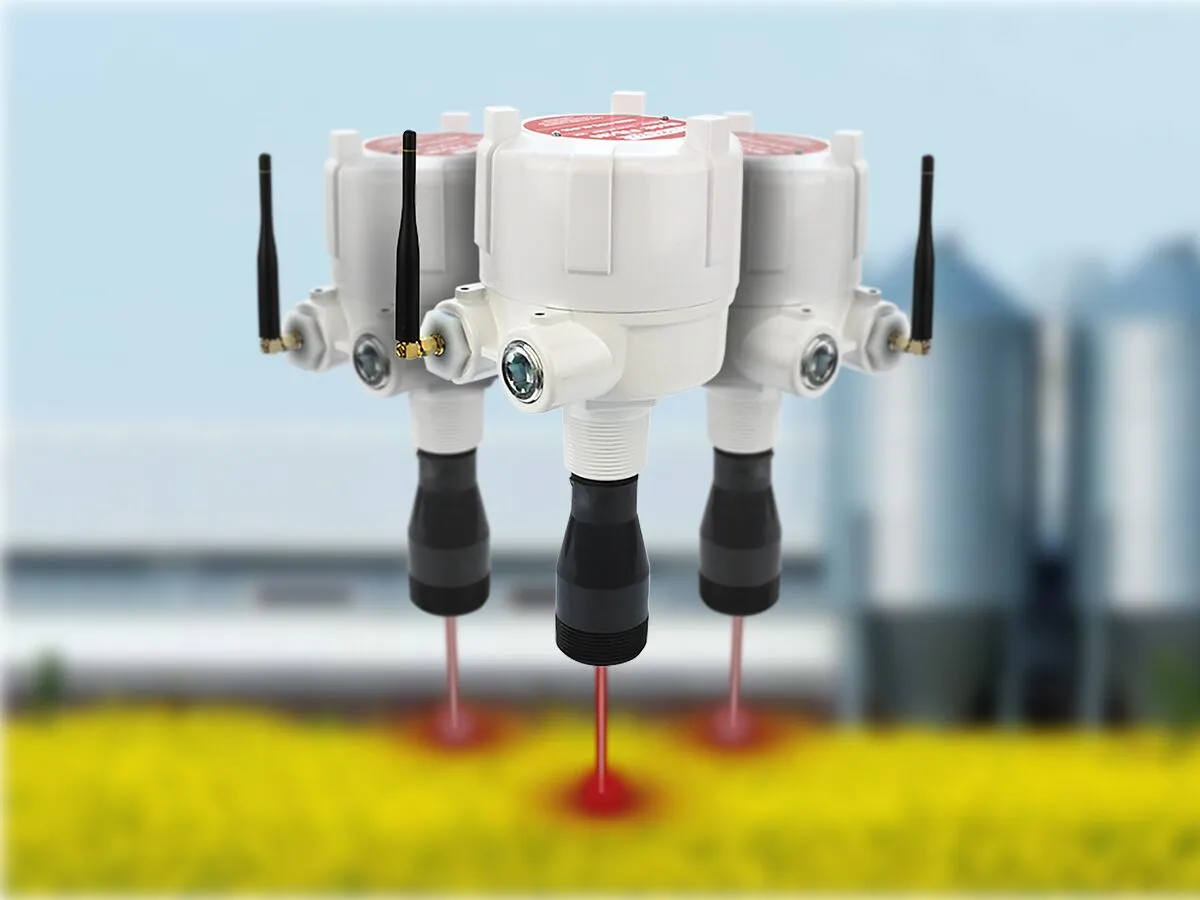
Narrow-beam laser level sensor for tall, narrow, and structure-filled silos, bins, and hoppers — where precise aiming matters more than anything else.
BinMaster’s authorized Laser Level Sensor distributor for the Great Lakes region —
65 years of knowledge put to work specifying the right sensor and accessories for your application.
Get an application-specific recommendation
Tell us about your application. Wm. Neundorfer & Co. will spec the laser level sensor—for your material, environment, and mounting location.
or call (440) 350-7460
Trusted across the Great Lakes region since 1959
Local Inventory
stocked in Painesville, OH
65 Years of
Bulk Material Handling Expertise
Serving the Great Lakes Region
OH, PA, WV, NY
Key Specs
Technology
Beam Angle < 1°
Virtually no divergence — aim past internal structure
Measuring Range
Up to 160 ft
Varies based on specific model
Accuracy
±1 in
8 readings per second
Why the laser level sensor is the standard for narrow, structure-filled, and low-dust vessels.
Aim the beam exactly where you need it
The less-than-1° beam has virtually no divergence, so you can thread it past ladders, augers, and corrugated walls and put the measurement right on the outlet or the bottom of the hopper. An adjustable flange gives up to 10° of aiming, and the firmware corrects for angled mounting automatically.
Fast, accurate readings the material can’t fool
Eight readings per second, accurate to ± 1 inch — and unaffected by surface angle, slope, texture, granularity, or material color. Laser doesn’t depend on dielectric constant, so it reads bulk solids of any dielectric and even opaque liquids the same way.
More than inventory — catch plugged chutes and buildup
The same sensor handles continuous level control, plugged-chute detection, and buildup monitoring in chutes, crushers, and restrictive process equipment where other technologies can’t fit or can’t aim tightly enough.
Built to stay clean and easy to commission
An integrated still-air barrier keeps dust off the optics, with an optional air purge for tougher spots. Configure and align in the field over USB — no need to fill or empty the vessel, and no field power required just to set it up.

Models
Three BinMaster laser sensors, all measuring with the same narrow-beam technology. They differ in how they’re powered, how far they reach, and where the data goes — the wired LL-100 is the high-accuracy industrial workhorse, while the battery-powered SPL-200 and FVL-200 add wireless install for solids inventory and feed bins. Send us the application and we’ll spec it for you.
| Model | Highlight | Best at |
|---|---|---|
| LL-100 | Wired high-accuracy laser. Up to 160 ft, ± 1 in, 8 readings/sec, 4–20 mA output. USB field configuration, still-air barrier, optional air purge. | Continuous level, plugged-chute detection, and buildup monitoring in low-dust industrial vessels |
| SPL-200 | Battery-powered and wireless. Lithium battery (3–5 yr) and LoRa radio send hourly readings to BinView or Binventory — no wiring, up to 98 ft. | Wireless solids inventory in silos and tanks where wiring is impractical |
| FVL-200 | Battery-powered and wireless. Lithium battery (3–5 yr) and LoRa radio send hourly readings to FeedView — no wiring, up to 35 ft. | Livestock feed bins on farms and at feed mills |
Configure your laser level sensor to your application
Lasers are deployed across a wide range of vessels, materials, and mounting locations. To ensure a reliable reading wherever it’s installed, each laser’s mounting, aiming, and accessories are configurable to your application. Not sure which configuration fits? Tell us about your application, and we'll spec the right mount for you.
Industries where the laser is the right solution
Serving industrial facilities across Ohio, Pennsylvania, West Virginia, and Western New York since 1959. Find your application below — or tell us about your vessel and we'll spec the right model.
Mining and Minerals
Aggregates, ores, salt, and minerals in crushers, load-out bins, and storage silos. A tight beam aims down crusher throats and narrow chutes where broad-beam sensors struggle.
Common fit:
LL-100 for crushers and plugged-chute detection; SPL-200 for wireless mineral inventory
Aggregate & Crushers
Sand, gravel, and crushed stone at aggregate yards and processing plants. Plugged-chute detection and buildup monitoring at transfer points.
Common fit:
LL-100 for chute and crusher level; ask about radar for dusty silos
Plastics and Resins
Virgin and regrind resin pellets, masterbatch, and ground polymer in day tanks and rail-car silos — low-dust pellet storage across Ohio and Pennsylvania.
Common fit:
LL-100 for tall narrow silos; SPL-200 + ResinView in BinCloud for wireless inventory
Grain and Feed
Grain, seed, fertilizer, and livestock feed in tall bins and farm silos. Battery/wireless install keeps feed and remote bins off the wiring budget.
Common fit:
FVL-200 + FeedView for feed bins; SPL-200 for grain and seed inventory
Bioenergy and Wood
Wood pellets, biomass, and densified fuel at pellet plants and biomass-fueled facilities. Narrow silos and low-dust pellet storage suit a focused beam.
Common fit:
LL-100 for narrow pellet silos; SPL-200 for wireless inventory
Chemical
Pulp, paper, chemicals, and opaque liquids in clean process vessels. Laser reads opaque liquids and low-dust solids where a precise, fast reading matters.
Common fit:
LL-100 for opaque-liquid tanks and clean process vessels
Food
Ingredients, granules, and low-dust powders in clean, controlled environments where a tight, fast measurement is needed.
Common fit:
LL-100 for low-dust ingredient vessels
Power Generation
Coal handling, limestone for FGD, and ash transfer. Plugged-chute detection and buildup monitoring at chutes and crushers.
Common fit:
LL-100 for plugged-chute detection and crusher level

