
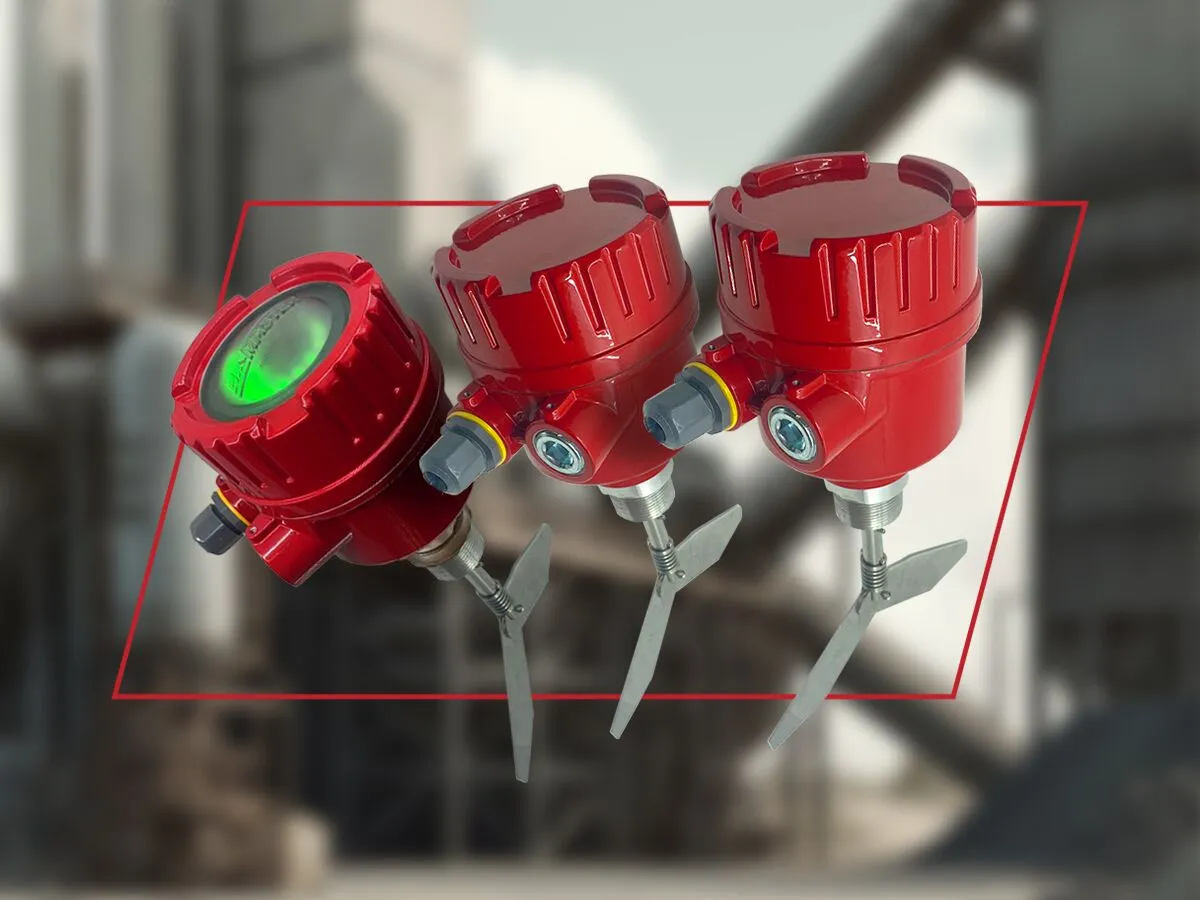
Rotary Point Level Sensor
Manufactured by BinMaster & Distributed by Wm. Neundorfer & Co.
The simple, rugged, proven level switch for high-, mid-, and low-level detection in bins, silos, and hoppers—powders, pellets, and granular bulk solids.
BinMaster’s authorized Rotary Point Level Indicator distributor for the Great Lakes region —
65 years specifying the right paddle, mount, and shaft extension for your application.
Get an application-specific recommendation
Tell us about your vessel. Wm. Neundorfer & Co. will spec the right rotary—paddle, mount, shaft, and process connection—for your material, environment, and mounting location.
or call (440) 350-7460
Trusted across the Great Lakes region since 1959
Local Inventory
stocked in Painesville, OH
65 Years of
Bulk Material Handling Expertise
Serving the Great Lakes Region
OH, PA, WV, NY
Key Specs
Technology
Rotary Paddle
Electromechanical
Measuring Range
2 to 100+ lb/ft³
Varies based on specific model
Paddle Options
19+
Styles for light, medium, and heavy materials.
Why the rotary is the most used point-level switch in Great Lakes grain, feed, cement, and plastics facilities
The simplest reliable level alarm you can buy
A paddle turns until material stops it. That’s the whole principle — no calibration, no dielectric settings, no signal to aim. Mount it, wire the relay to a light, horn, or motor starter, and it works. Decades of bins across the Great Lakes run on rotaries for exactly this reason.
Handles nearly any dry bulk solid
Powders, pellets, granules, and flakes from roughly 2 to over 100 lb/ft³ — grain, feed, cement, fly ash, plastic resin, sugar, sand, fertilizer. Swap the paddle to match the material density and the same head covers light fluff to heavy aggregate.
Built to shrug off dust, moisture, and vibration
The cast housing is moisture-impervious with a screw-off cap for easy access to every component. The mechanical BMRX-100 carries no circuit board at all. Heat tubes, sealed shaft extensions, and stainless connections handle hot, corrosive, or food-grade vessels.
Fail-safe and process control when you need it
Wire a rotary to start or stop equipment automatically — shut down a fill auger at high level, or kick on a conveyor at low level. The BMRX-200 and BMRX-300 default to a safe condition on power loss, and the BMRX-300’s lid LED shows rotating, covered, or fault status visible from up to 100 feet away.

Models
BMRX (Formerly MAXIMA Series)
| Model | Highlight | Applications |
|---|---|---|
| BMRX-100 | Heavy-duty electromechanical rotary. Rugged mechanical design, no printed circuit board, SPDT switch. | Tough industrial processing where simple, low-maintenance point detection is all you need |
| BMRX-200 | Adds PCB controls, DPDT relay output, and fail-safe relay logic that defaults to a safe condition during power failure. | High- or low-level detection where a power loss must trigger a safe state; dual switching outputs |
| BMRX-300 | Formerly MAXIMA+. Fail-safe digital rotary with lid-integrated LED, self-diagnostics, and adjustable time delays | Critical process control and overfill prevention; at-a-glance status from up to 100 feet away |
| Mini-rotary | Economical, compact paddle switch with slow-speed synchronous motor and adjustable torque sensitivity. SPDT. | Small bins, hoppers, and mixers — plastics, food, seed, chemicals, and dry bulk solids in tight spaces |
Configure your rotary to your application
Rotaries are used across a wide range of materials, vessel types, and mounting locations. To ensure reliable detection wherever it’s deployed, each rotary’s paddle, mount, and shaft extension is configurable to your application. Not sure which configuration fits? Tell us about your application, and we'll spec the right mount for you.

Industries where the rotary is the point-level standard
Serving industrial facilities across Ohio, Pennsylvania, West Virginia, and Western New York since 1959. Find your application below — or tell us about your vessel and we'll spec the right model.
Grain and Feed
Corn, soybean meal, wheat, DDGs, and ground feed in elevators, feed mills, and ethanol plants in bins and silos.
Common fit:
BMRX-200 + 3-vane SS paddle (GRP-1) for high level; nylon paddle for light feed
Cement and Aggregate
Cement, fly ash, slag, lime, and aggregate in batch plants and storage silos. Heat tubes handle hot fly ash; heavy single-vane paddles handle dense aggregate.
Common fit:
BMRX-300 + heavy single-vane paddle (GRP-3) + heat tube for hot ash
Plastics and Resins
Virgin and regrind resin pellets, masterbatch, and ground polymer in day tanks, hoppers, and railcar unloading silos. Mini-rotaries fit small hoppers and mixers.
Common fit:
Mini-rotary for small hoppers; BMRX-200 + 3-vane paddle for storage silos
Power Generation
Coal, fly ash, limestone for FGD, and bottom ash storage. Fail-safe rotaries protect against overfill on critical bins; heat tubes protect electronics on hot ash.
Common fit:
BMRX-300 (fail-safe) + heat tube + SS paddle for hot fly ash
Mining and Minerals
Aggregate, salt, lime, fertilizer, and frac sand in storage silos and load-out bins. Heavy and large-particle paddles handle abrasive, dense bulk solids.
Common fit:
BMRX-100 or BMRX-200 + heavy single-vane (GRP-31) or belt paddle (GRP-24)
Bioenergy and Wood
Wood pellets, sawdust, bark, and biomass at pellet plants and biomass-fueled facilities. Very-light paddles create enough resistance for low-density fluff.
Common fit:
BMRX-200 + very-light 3-vane paddle (GRP-25/GRP-28) for sawdust

