
How to Choose the Right Conveyor Belt Scale for Your Process
A guide to selecting the correct Bulk Pro Systems belt scales for your application
Conveyors are an integral part of almost all industries that work with dry bulk materials. They are used to feed crushers, build stockpiles, fill railcars, move material from one process point to the next, and so much more. When you can’t accurately measure the flow of material, downstream equipment gets overloaded or starved, inventory numbers drift and the guesstimates of how much material is where begins.
A conveyor belt scale solves these problems, but only if it’s the right scale for the job. Buy more accuracy than you need and you’ve overspent. Buy too little and the numbers you rely on can’t be trusted.
Wm. Neundorfer & Co. has more than 60 years of experience in bulk material handling. We partner with Bulk Pro Systems to provide our customers with conveyor belt scales. This guide walks through how we help customers put together the right BulkPro belt scale system. If you’re new to belt scales, start with our earlier article, Conveyor Belt Scales: How They Work and the Benefits They Provide.
Three Pieces, One System
A BulkPro belt scale system is made up of three components:

Belt Scale
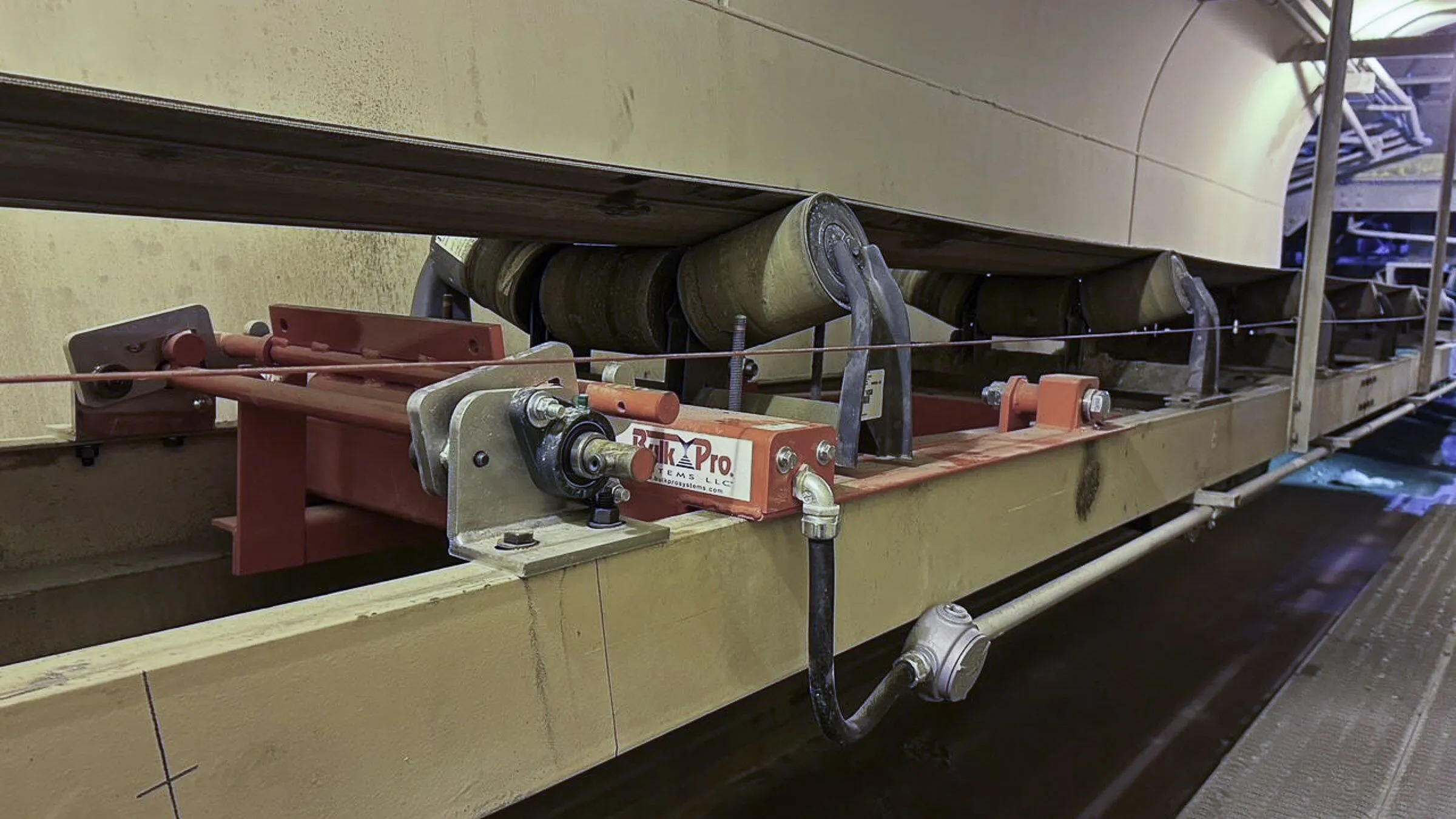
The belt scale mounts in the conveyor under the belt and uses load cells to weigh the loaded section of belt, subtracting the known weight of the empty belt.

Speed Sensor
The speed sensor mounts to a non-driven rotating shaft on the conveyor and measures how fast the belt is moving.
Integrator
The integrator combines the weight and speed readings into a real-time flow rate and a running total of material moved.
The belt scale and speed sensor both come in multiple models to optimize the belt scale system to the customer’s individual application. The integrator is a single unit that is used no matter which combinations of belt scales or speed sensors are selected.
Know How You’ll Use the Measurements
Before looking at and comparing models, you’ll first need to determine what you are trying to accomplish with the measurements that the belt scale system provides. We have found belt scales are suited to help with:
Process controls
Belt scales can help solve process control problems where equipment (crushers, screens, mills, etc.) being fed by your conveyors are being starved of material, over fed, or fluctuating between both. They provide the data necessary to adjust the feed rate of the conveyors to optimize the performance of the equipment being fed.
Production and inventory
They can help with addressing shortages or over production of materials stored in stockpiles.
By calculating the weight of material that flows over the conveyor belt, the belt scale enables tracking output to stockpiles, allowing operations to plan with confidence.
Load-out and incoming product confirmation
If you’re having issues with product load-out or under delivery of incoming material belt scales can help. With real time insight into how much material is coming in and how much product is going out operators can catch discrepancies before they become major headaches.
Once you have determined that a belt scale is the right product for addressing the problem you’re facing, then you’re ready to work through selecting the right model.
Factors to Consider for Model Selection
Required accuracy.
BulkPro scales range from ±1% to ±0.125%. That difference sounds small until you scale it up. On a belt moving 500,000 tons a year, ±1% means up to 5,000 tons of uncertainty. At ±0.125%, it drops to about 625 tons. For process control, 5,000 tons may be acceptable. For material you’re billing on, it probably isn’t.
Belt speed and capacity.
Fast, high-tonnage belts need a longer weighing section to capture an accurate reading, which is why multi-idler scales are the choice for high-speed, high-capacity conveyors. For extreme applications above 10,000 TPH, BulkPro offers special super heavy-duty carriages.
Operating environment.
Dust, moisture, outdoor exposure and material build-up all affect long-term accuracy. Look for rugged construction and designs that shed build-up rather than collect it.
The value of the material.
Lower-value materials and non-critical flows rarely justify top-tier accuracy. High-value materials almost always do.
Selecting the Belt Scale
The belt scale is where accuracy is decided. BulkPro offers three models, with the N-64 available in two-idler and four-idler versions:
| Model | Idlers | Accuracy | Best For |
|---|---|---|---|
| N-61 | Single | ±1% | Economical process control on non-critical, lower-value flows |
| N-62 | Single or Dual | ±0.5% | Heavy-duty process control, load-out and inventory |
| N-64-2 | Dual | ±0.25% | High-speed, high-capacity belts needing high accuracy |
| N-64-4 | Quad | ±0.125% | Highest accuracy for load-out and incoming product confirmation |
N-61 Single Idler
Belt Scale
The N-61 offers the best price-to-accuracy ratio in the lineup, with guaranteed accuracy of ±1%. Its heavy-duty, all-in-one design makes installation straightforward. It’s the right fit when you need an instantaneous flow rate and totalized tonnage for process control, such as feeding crushers, screens and stockpiles, but the material isn’t being bought or sold by the ton.
N-62 Single and Dual Idler Belt Scale
The N-62 steps accuracy up to ±0.5% and is built for heavy-duty weighing. It delivers precise feed control to crushers, mills and screens, and it’s accurate enough to regulate product load-out while also monitoring production and inventory. For many plants, it’s the most versatile choice.
N-64 Two-Idler and Four-Idler Precision Belt Scales
The N-64 is designed for high-speed, high-capacity belts where accuracy matters most. The two-idler N-64-2 maintains ±0.25%, and the four-idler N-64-4 maintains ±0.125%, the highest in the lineup.
The N-64 weighbridge uses four precision load cells in a fully floating design with no pivots or easily worn parts. Its steel tube construction minimizes material build-up, which helps the scale hold its accuracy over time. It’s the go-to choice for confirming incoming product, measuring outgoing load-out and managing inventory of high-value material.

Selecting the Speed Sensor
A belt scale can’t calculate flow rate without knowing belt speed, so every system includes an N-60 series speed sensor. The choice is which type fits your conveyor. N-60 series speed sensors mount to a non-driven rotating shaft on the conveyor and send the integrator a frequency signal proportional to belt speed. The N-60 is available in three types:
N-60: Operates at 50 pulses per revolution and is the most widely used of the three types. The N-60M version uses an M16 metric coupling in place of the UNC coupling.
N-60X: The CSA (cCSAus) approved unit, also operating at 50 pulses per revolution. In addition to CSA approval, it’s approved for installation in Class II, Div. 1 & 2, Groups E, F & G hazardous locations.
N-60B: Uses an encoder instead of a stepper motor and operates at 600 pulses per revolution. It’s designed for low and very low speed conveyors and feeders.
Not sure which one fits? Our team can help you choose. All N-60 series sensors are also direct replacements for Thermo Ramsey belt scale speed sensors, which makes upgrading older equipment much simpler.
The Constant: The 6101 Series Integrator
Whichever scale and speed sensor you choose, the integrator is the same. The 6101 Series Integrator is the brain of every BulkPro belt scale system. It takes the load cell signals from the scale and the frequency signal from the speed sensor and converts them into rate and total. Physical keys make it easy to operate with gloves on, and it’s built for both indoor and outdoor installations. The 6101 can also retrofit into most existing belt scale systems, adding better control and data collection without replacing the whole scale.
Quick Selection Guide
Pick your scale
- Non-critical process control on a budget → N-61
- Heavy-duty process control, load-out or inventory tracking → N-62
- High-speed, high-capacity belt that needs high accuracy → N-64-2
- Material bought or sold by the ton → N-64-4
Pick your speed sensor
- Standard conveyor → N-60
- Standard conveyor needing a metric coupling → N-60M
- Hazardous location or CSA approval required → N-60X
- Low or very low speed conveyor or feeder → N-60B
6101 Series Integrator
The Integrator comes with every system. If you’re upgrading an aging system that still has a sound weighbridge, the 6101 integrator and an N-60 series speed sensor can often be retrofitted to it.
Getting Accurate Results After Installation
Even the best scale only performs as well as it’s installed and maintained. Proper installation, periodic calibration and routine maintenance are what keep a belt scale accurate year after year. A few practices make a big difference:
- Install the scale on a straight section of conveyor where material loading is consistent.
- Keep the idlers around the scale properly aligned.
- Zero and calibrate the scale on a regular schedule.
- Keep the weighbridge clear of material build-up.
A belt scale also works best as part of a well-protected conveyor. BulkPro’s belt misalignment switches, rip detectors, tramp metal detectors, speed switches and pull cord switches help keep the belt, and the scale, running safely.
Why Work With Wm. Neundorfer & Co.
As a trusted BulkPro Systems distributor, we keep a well-stocked supply of BulkPro products at our facility in Painesville, Ohio. Our team helps you evaluate your belt speed, capacity, material and data needs so you get the accuracy your process requires without paying for more than it needs. We serve customers throughout Ohio, Western Pennsylvania, West Virginia and Western New York.
Find the Right Belt Scale for Your Conveyor
Not sure which model fits? Have your belt width, belt speed, capacity and material type handy, and our team will help you narrow it down.
For more information or details on how we can help you select the right equipment for your application, contact Wm Neundorfer & Co today.
We have the expertise and experience to ensure you get the advice and recommendations you require for your specific application.
